
You ask a question because you want to understand. The other person hears criticism.
You stay quiet because you are considering the options. Someone decides you are unhappy with the proposal.
You glance at your phone while a colleague speaks. You are checking an urgent update, but they wonder whether you are listening.
These everyday moments illustrate perception in communication: the meaning someone takes from your words and behaviour can differ from the meaning you intended.
That gap matters. It can affect whether people share information, ask for help or feel confident about what happens next. Understanding it gives you a practical way to improve conversations before a misunderstanding becomes a problem.
Key Takeaways
- Your intention and their perception can differ.
- Words, tone and behaviour work together.
- Body language offers clues, not proof.
- Make your purpose clear.
- Check understanding rather than assume it.
- Follow-through is part of communication.
What is perception in communication
Perception in communication is how someone notices and interprets a message. They hear your words, notice how you deliver them and form a view of what you mean.
Their interpretation also draws on the situation, your previous interactions and their own experiences and expectations. Two people can hear the same words and reach different conclusions.
Imagine a manager saying, “Can we talk about your report?” A colleague expecting useful feedback may welcome the conversation. Someone who has previously faced harsh criticism may expect trouble.
The wording is identical. What each person brings to it is different.
You can influence the impression you create. You cannot control every interpretation. The useful skill is to make your purpose clearer and check understanding when the response suggests a gap.
The impression you create begins before your explanation
Picture someone arriving for a meeting. You continue typing while they introduce themselves, then say, “Go ahead. I’m listening.”
You may be able to follow every word. They may still feel they are competing for your attention.
Now imagine you pause, turn towards them and say, “Let me finish this line, then you’ll have my attention.” You finish, put the task aside and invite them to continue.
The difference is that your behaviour supports your words. The person has a clearer reason to believe you are ready to listen.
An early impression can influence the conversation that follows, but it is not a final verdict. People can revise their view as they gain more information. Your next contribution can help them do that.
Your words and delivery work together
A sentence does not arrive on its own. Pace, volume, pauses and emphasis can affect how it is understood.
Consider, “What happened here?” Said calmly, with time to answer, it can invite an explanation. Delivered sharply while interrupting, it can feel like an accusation.
The question may be necessary in both cases. Making your purpose explicit gives the other person less to guess about: “Talk me through what happened so we can work out the next step.”
You do not need to soften every message or avoid difficult questions. You need wording and delivery that help the other person understand what you are trying to achieve.
Directness can create clarity. Directness without context can leave someone uncertain about your intention.
Body language gives clues that need context
Your posture, expression and attention can contribute to the impression someone forms. But a single gesture does not reveal a person’s thoughts.
Folded arms might reflect comfort, temperature, habit or a physical need. Limited eye contact does not automatically mean disinterest or dishonesty. People differ in how they communicate, including because of culture, disability and neurodivergence.
The same caution applies to how others interpret you. You might lean back to think while someone assumes you have lost interest.
Rather than trying to perform an ideal set of gestures, aim to make your attention and purpose understandable. If you need to look away to think, you can say, “Give me a moment to consider that.” If you need to take notes, explain why.
Treat a change in someone’s response as a reason to explore, rather than proof of what they are thinking.
Four gaps between intention and perception
Decisive can sound impatient
You say, “We need a decision today.” You intend to keep the work moving. Someone may hear that their concerns are unwelcome.
Try: “We need a decision today. What information or concerns do we need to consider before we make it?”
The deadline remains clear, and there is a defined opportunity to contribute.
Quiet can look like disagreement
You pause because you want to think carefully. Others may interpret the silence as resistance, confusion or agreement.
Try: “I’m considering how this would work. Give me a moment, then I’ll explain my view.”
You make the purpose of your silence visible without rushing your answer.

Efficient can feel dismissive
You reply, “Just send me an email.” You want a written record. The other person may feel that their concern has been brushed aside.
Try: “Please email me the details so I can review them properly. I’ll come back to you by tomorrow afternoon.”
Only offer that timescale if you can meet it. A clear promise creates an expectation you must manage.
Curious can sound critical
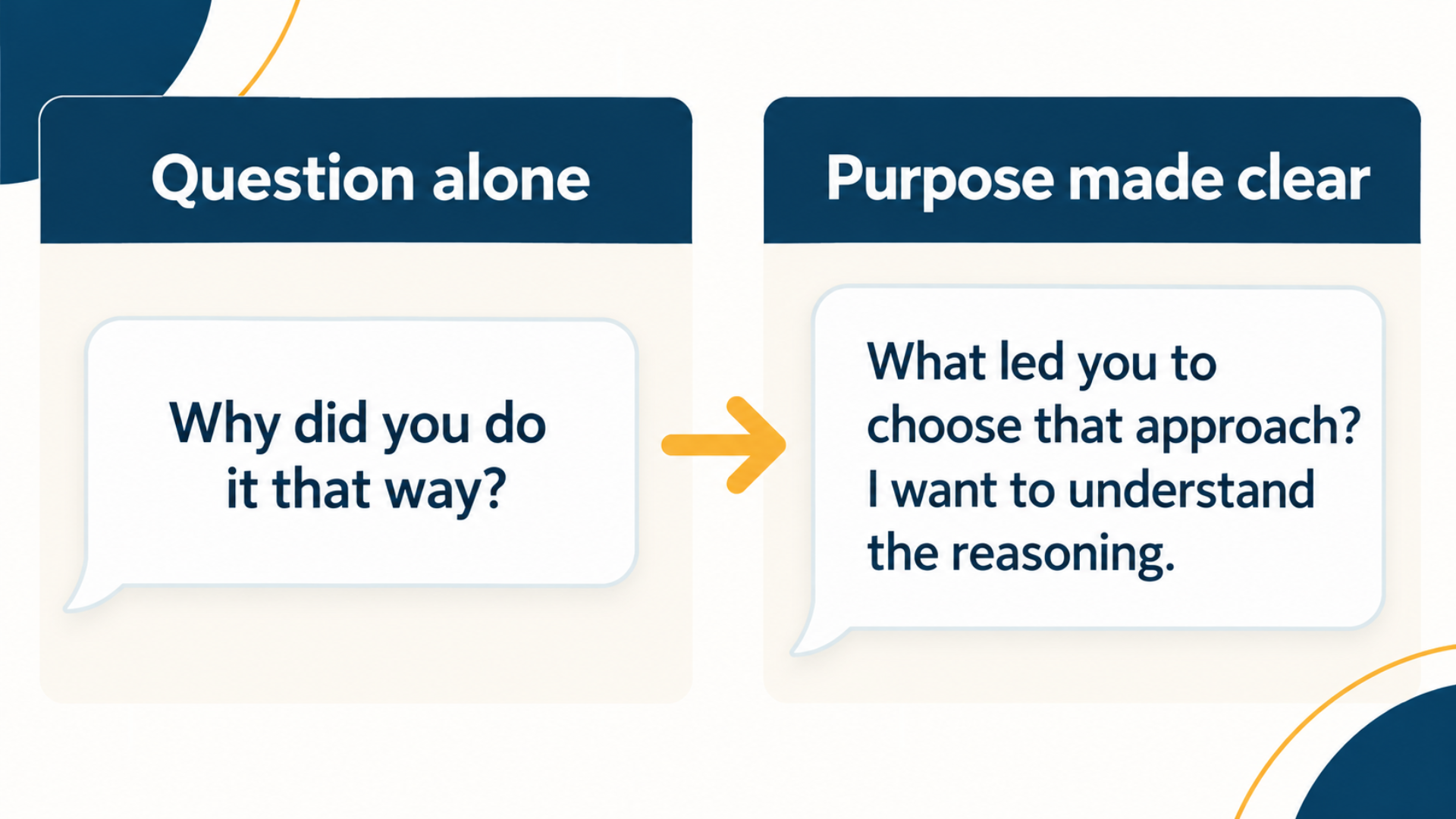
You ask, “Why did you do it that way?” You want to understand the reasoning. Someone may hear, “You did it wrong.”
Try: “What led you to choose that approach? I want to understand the reasoning before we decide what to do next.”
These examples are ways to clarify purpose, rather than scripts that guarantee a response. Listen to what happens next and adapt to the person and situation.
Check the impression rather than defend the intention
When someone reacts differently from how you expected, it is tempting to explain why they should not have taken it that way.
“I didn’t mean it like that” may be true, but it does not yet establish what they heard or resolve the confusion.
Start with a question: “How did that come across?” Or clarify a specific possibility: “I’m asking about the process. Did my question sound as though I was blaming you?”
Give them room to answer. Then explain your intention and, where necessary, change your contribution.
For example: “I can see why that sounded abrupt. I need the update today, but I also need to understand what is getting in the way. What do we need to resolve?”
You can acknowledge the effect of your delivery while keeping the original requirement clear. That makes it easier to return to the work together.
Use the Communication Compass model to close the gap
The Communication Compass gives you a practical sequence: Observe → Understand → Adapt → Deliver.
Observe what is happening. Has someone stopped contributing? Are they asking a question you thought you had answered? Notice the change without assigning a motive.
Understand by checking. Ask what is unclear or how they interpreted your message. Consider whether your assumptions, emotions or previous experiences are affecting your own reading of the situation.
Adapt your contribution. Explain the purpose, change the wording, allow more thinking time or choose a more suitable channel. Adapt to what you have discovered.
Deliver a clear outcome. Confirm the decision, the next step and who owns it. If the conversation has corrected a misunderstanding, check that you now share the same understanding.
For instance, after a brief message creates concern, a short call might establish that the issue is competing deadlines rather than dissatisfaction with someone’s work. The outcome could be an agreed priority and a revised delivery time.
What you do afterwards shapes perception too
A helpful conversation can lose its value if the promised action never happens.
If you say you will respond tomorrow and then remain silent, the other person may start to doubt whether their issue matters to you. Repeated experiences can influence how they interpret your next assurance.
Make commitments you can reasonably keep. If circumstances change, explain that before the person has to chase you and agree a realistic next step.
Consistency does not mean being perfect. It means giving people a reliable basis for understanding your words and actions, including when something goes wrong.
Try this in your next conversation
Choose a conversation where your intention could easily be misread, such as giving feedback, requesting an update or questioning a decision.
Before it begins, ask yourself: “What do I want this person to understand, and what might be unclear in how I express it?”
During the conversation, make your purpose explicit. Notice the response and check any uncertainty rather than guessing at its meaning.
At the end, confirm what has been agreed. Afterwards, follow through on your contribution.
Improving perception in communication begins with recognising that your intention is only part of the conversation. What someone understands is the part you need to discover.
FAQ’s
Q. What is poor communication in the workplace?
A. Poor communication in the workplace occurs when people lack the clear, timely information or shared understanding needed for their work. It can involve unclear instructions, missing details, unchecked assumptions or messages that change during handovers.
Q. What does CCDDRR stand for?
CCDDRR stands for Communication, Consumption, Distribution, Dilution, Resolution and Results. I use these six Message Mapping checkpoints to review how information reaches people, supports decisions and leads to outcomes.
Q. How can I stop messages losing meaning?
Make the main point, context and required action clear. Check understanding, identify who needs the information and provide a useful written reference. Keep important conditions visible and follow up on the result.
FAQ’s
Q. Why does perception matter in communication
A. Perception influences the meaning people take from a message and how they respond. If the meaning they hear differs from your intention, they may act on an understanding you do not share. Checking that gap helps you clarify the conversation.
Q. Can you control how people perceive you
A. You can influence perception through clear wording, appropriate delivery and consistent actions. You cannot control every interpretation because other people bring their own experiences and expectations. Ask and clarify rather than assume you have created the intended impression.
Q. How can you check perception without sounding awkward
A. Use a short question connected to the conversation, such as “Was the priority clear?” or “How did that come across?” Ask with room for an honest answer, then respond to what you learn.
Q. Is body language more important than words
A. There is no useful universal percentage that tells you how much of every message comes from body language. Words, delivery, context and behaviour can all matter. Focus on whether they support a clear meaning, and avoid treating a gesture as proof of someone’s intention.
Final Thoughts
You know what you intended to communicate. The other person has your words, delivery and behaviour to help them work it out—and their own experiences influence what they perceive.
Better communication starts with recognising that gap. Make your purpose clear, explore responses you do not understand and check what has been agreed. If your message lands differently from how you intended, use that information to adapt.
You cannot control every impression someone forms. You can give them a clearer basis for understanding you—and reinforce it through what you do next.
