
You bring a proposal to a meeting.
One colleague wants to know what it will achieve. Another asks for the evidence. A third considers how it will affect the team. Someone else starts suggesting possibilities you haven’t explored (or even thought of).
Same proposal. Different priorities.
Understanding communication styles in the workplace helps you recognise what someone may need from the conversation. That gives you a better starting point for explaining your message, answering their questions and helping them make an informed decision.
You don’t have to know someone’s entire personality to communicate more effectively with them. You do need to pay attention to the person in front of you.
Key Takeaways
- People may prioritise results, evidence, relationships or possibilities in a conversation.
- DACE offers a practical framework for recognising these communication preferences.
- Look for patterns in what people say, ask and respond to.
- Use those clues to guide your questions, rather than deciding you have someone figured out.
- Keep your facts, meaning and required action consistent when adapting your delivery.
What do we mean by communication styles?
The term “communication styles” is used in different ways.
You may have encountered descriptions such as passive, aggressive, passive-aggressive and assertive. Those describe how people express themselves and handle their own and others’ needs.
This article takes a different perspective: what someone may prioritise when receiving information and taking part in a conversation.
Do they want the result first? Do they need supporting evidence? Are they concerned about the people involved? Do they want to explore the possibilities?
These preferences can affect what they notice, which questions they ask and what makes your message useful to them.
Introducing DACE: four communication preferences
DACE is the framework I use within The Communication Compass to help people recognise and respond to communication preferences.
It stands for:
Driver. Analyst. Connector. Explorer.
Each gives you a practical starting point for observing a conversation.
Driver: “What are we trying to achieve?”
A Driver preference often shows up as a focus on results, decisions and progress.
Someone may ask what you recommend, when something will happen or what needs to be done next. They may become impatient if the point is buried in a lengthy explanation.
A useful response: lead with the outcome or required action, then provide the relevant supporting detail.
Analyst: “What supports this?”
An Analyst preference often shows up as a focus on evidence, accuracy and reasoning.
Someone may ask how you reached your conclusion, which figures you used or what remains uncertain. Their questions may be an effort to understand the proposal thoroughly.
A useful response: explain the relevant facts and reasoning, distinguish what you know from what you assume, and allow space for questions.
Connector: “How does this affect the people involved?”
A Connector preference often shows up as a focus on relationships, cooperation and the effect on others.
Someone may ask how the team feels, who needs support or whether people have been consulted.
A useful response: explain the human impact, acknowledge concerns and make responsibilities and support clear.
Explorer: “What else could we do?”
An Explorer preference often shows up as a focus on ideas, opportunities and possibilities.
Someone may suggest alternative approaches or connect your proposal with a wider opportunity.
A useful response: explain the purpose, allow room for relevant ideas and clarify the boundaries and next step.
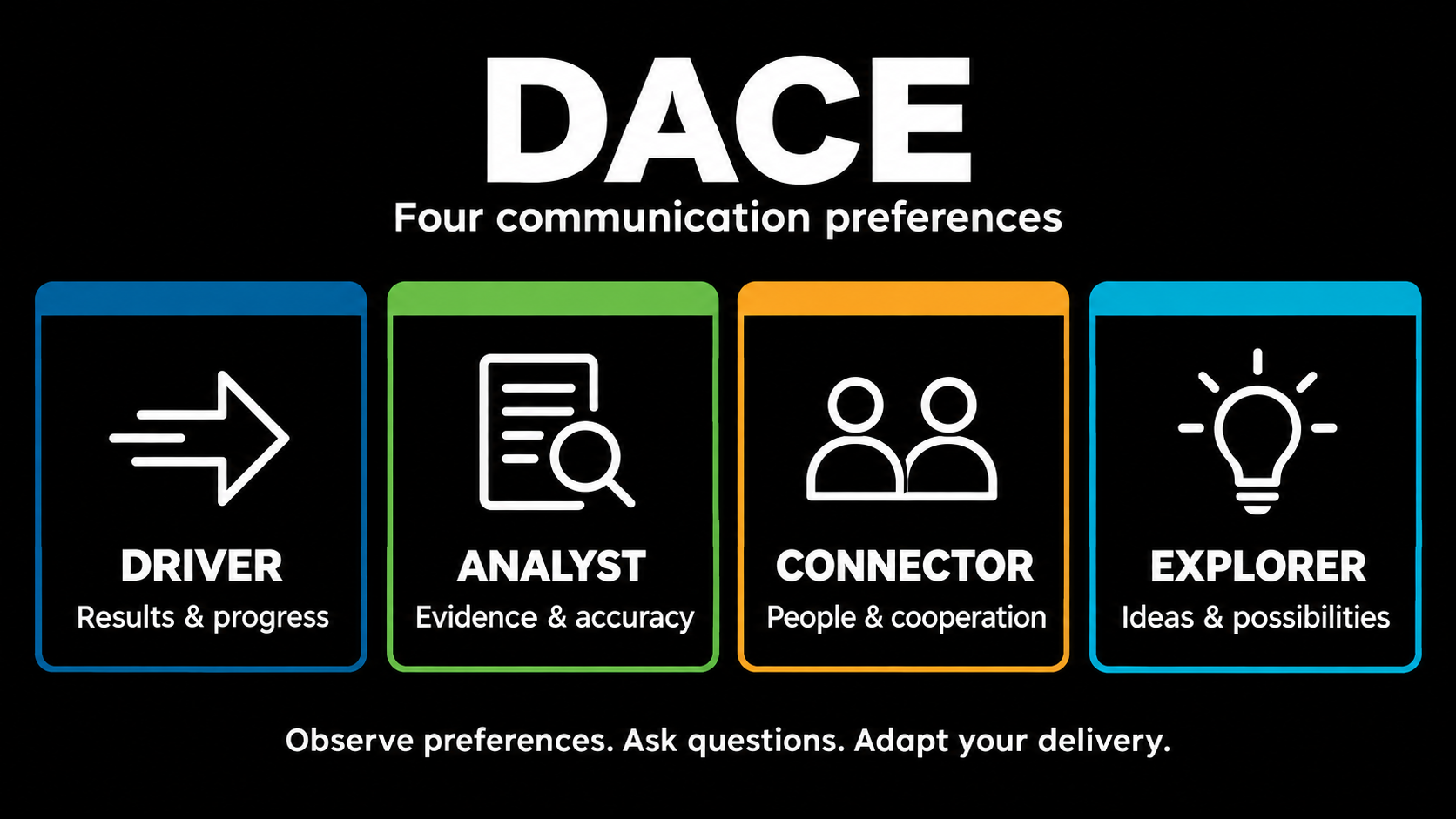
Communication styles at a glance
| DACE preference | What they may prioritise | What you might notice | How to respond |
| Driver | Results and progress | Questions about the outcome, decision or deadline | State the point and required action early |
| Analyst | Evidence and accuracy | Questions about facts, reasoning or missing detail | Provide relevant evidence and explain your reasoning |
| Connector | People and cooperation | Questions about impact, involvement or support | Address the people affected and how they will be supported |
| Explorer | Ideas and possibilities | Alternatives, wider connections or new approaches | Explain the purpose and make room for ideas within clear boundaries |
Treat these as clues to investigate.
A person who wants a quick answer in one conversation may need detailed evidence in another. The stakes, their responsibilities and their knowledge of the subject can all change what they need.
How to recognise preferences in a conversation
Start with what you can observe.
Notice what they ask first
Their first question may reveal what matters most at that moment.
“What decision do you need from me?”
“Where did those figures come from?”
“Have the team been told?”
“Could we approach this differently?”
None proves a particular style. Each gives you something useful to follow up.
Notice the detail they request
Do they ask you to get to the point, explain the sequence, discuss the effect on colleagues or explore alternatives?
Respond to that request. You don’t need to finish a prepared explanation in its original order.
Notice what brings them into the conversation
Perhaps they become more engaged when you discuss the result. Perhaps they lean into the conversation when you explain the evidence or invite ideas.
Check your interpretation with a question. An expression or gesture alone won’t tell you what someone is thinking.
You could ask:
“Would you like the recommendation first, or the background?”
“Which part would you like me to explain further?”
“Is there anything we haven’t considered?”
Observe first. Ask questions. Adjust as you learn.
The same workplace message expressed four ways
Here is an illustrative example.
A client has brought a proposal deadline forward from Friday to Wednesday at noon. Each department must send its figures to Maya by Tuesday at 3pm so she can prepare the final proposal.
The team can change how it gathers the figures, but the figures still need to be checked. Anyone expecting a problem must tell Maya by Monday at noon.
Those facts stay consistent. What changes is the order and emphasis.
For a Driver preference
“The client now needs the proposal by Wednesday at noon. Send your checked department figures to Maya by Tuesday at 3pm. You can adjust how you gather them. If delivery is at risk, tell Maya by Monday at noon.”
The action and deadlines come first.
For an Analyst preference
“The client has moved the proposal deadline from Friday to Wednesday at noon. Maya needs each department’s checked figures by Tuesday at 3pm to prepare it. The checking requirement stays the same, although you can adjust how you gather the figures. Tell Maya by Monday at noon if you expect a problem.”
The explanation connects the change, the preparation time and the checking requirement.
For a Connector preference
“We need to coordinate across departments because the client now needs the proposal by Wednesday at noon, rather than Friday. Please send your checked figures to Maya by Tuesday at 3pm. You can adjust how you gather them. If the timing creates a problem for your department, tell Maya by Monday at noon so we can discuss what’s needed.”
The message emphasises coordination and the opportunity to raise concerns.
For an Explorer preference
“We have room to adjust how we gather the figures to meet the client’s earlier proposal deadline: Wednesday at noon instead of Friday. The boundaries are clear—send checked department figures to Maya by Tuesday at 3pm, and tell her by Monday at noon if you expect a problem. What practical change would help you achieve that?”
The message opens with flexibility, then establishes the requirements.
These are examples of emphasis, rather than scripts you must follow word for word.
Everyone needs the relevant facts. Everyone needs to understand the deadlines, responsibility and required action.
Keep the meaning. Change the delivery.

Why understanding preferences matters
When you recognise what someone needs from a conversation, you can make your contribution more useful.
You may avoid spending several minutes on background before giving a decision-maker the recommendation they need.
You may recognise that a colleague’s detailed questions require evidence you haven’t yet provided.
You may discover that a concern about the team needs addressing before a proposal can move forward.
You may give an idea space to develop, while keeping the conversation connected to the decision at hand.
The value is practical: a clearer exchange, better questions and a stronger basis for deciding what happens next.
Use DACE with curiosity
It is easy to hear one question and decide, “They’re an Analyst.”
That conclusion can stop you paying attention.
Instead, think:
“They’re asking for evidence. What do they need to understand?”
Likewise, a request for a quick answer may reflect time pressure. A question about colleagues may reflect someone’s responsibility for the team.
Your framework should help you discover more about the conversation.
Don’t start by deciding. Start by discovering.
Check whether your message was understood
Adapting your delivery is part of the job. You still need to check what the other person understood.
In the deadline example, you could ask:
“Before we finish, can we confirm what each department is sending to Maya and by when?”
That creates an opportunity to uncover a misunderstanding or an obstacle.
A nod may tell you someone heard you. A clear explanation of the next step gives you more information about what they understood.
FAQ’s
Q. What are communication styles in the workplace?
The phrase can refer to how people express themselves, such as assertively or passively, or to their preferences for receiving and discussing information. This article uses DACE to explore preferences around results, evidence, people and possibilities.
Q. What does DACE stand for?
Driver, Analyst, Connector and Explorer. It is the framework I use within The Communication Compass to help people recognise and respond to communication preferences.
Q. Can someone show more than one preference?
Yes. You may notice several preferences in the same person or conversation. Pay attention to what they need in the current situation.
Q. Do I need to identify someone’s style before speaking to them?
No. Begin with a clear message, listen to their questions and adapt as you learn more.
Q. Does adapting mean giving different people different information?
The relevant facts and meaning should stay consistent. You can change the order, emphasis, pace and amount of explanation to help someone understand.
Final Thoughts
Understanding communication styles in the workplace begins with paying attention.
What is this person asking? What do they need to understand? What would help them assess the information and decide what to do?
DACE gives you a practical starting point for exploring those questions.
Observe the clues, understand what matters, adapt your delivery and deliver a clear message. Then check what was understood.
The more you understand who you’re talking to, the better placed you are to make the conversation count.
