
Everyone Agreed. So Why Did Things Go Wrong?
Poor communication in the workplace can be hard to spot when everyone seems to agree.
The meeting ends. Heads nod. Nobody asks a question.
Then Friday arrives.
The task is unfinished. Two people thought someone else owned it. Another understood the deadline differently.
Now imagine asking each person what happened.
“I thought you meant next Friday.”
“I was waiting for approval.”
“I didn’t realise that part was mine.”
These are illustrative examples, but they reveal a useful question.
Did everyone leave with the same understanding?
A message can sound clear to the speaker while leaving the listener unsure about what happens next.
Sending information is one step. Checking what someone understood is another.
That distinction matters because communication shapes the information people use when making decisions.
Here are seven warning signs worth investigating.
Key Takeaways
- Silence does not confirm understanding.
- Clear actions need owners and deadlines.
- Check meaning before work begins.
- Discover what happened before assigning blame.
- Adapt your delivery to the person.
- Follow important messages beyond the first conversation.
Seven Signs of Poor Communication in the Workplace
These signs are prompts to investigate, rather than proof that someone communicated badly.
A missed deadline could also reflect workload, missing resources or changed priorities.
Start by discovering what happened.
1. People Leave With Different Understandings
Ask three people what was agreed. You hear three different answers.
One remembers a firm decision. Another remembers a suggestion. The third thought the discussion was still open.
Before ending an important conversation, ask someone to describe the next step.
Try:
“What have we agreed, and what needs to happen now?”
Compare their answer with your intended meaning. Clear up any gaps while everyone is still available.
For example, “review the proposal” could mean checking figures, approving costs or rewriting the whole document.
Name the task you actually need.
A short written summary can then give everyone a shared reference.
Include the decision, action, owner and deadline.
2. Silence Is Treated as Agreement
You explain a change and ask, “Everyone happy?”
Nobody speaks.
That tells you nobody spoke. It does not tell you why.
Someone may agree. Someone may be unsure. Someone may need time to consider the change.
Avoid choosing an explanation without checking.
Ask a question that invites useful information:
“What could make this difficult to carry out?”
Or:
“Which part needs more detail before we begin?”
Allow time for an answer. Offer another way to raise concerns if the group setting makes that difficult.
You are creating space to discover what a nod or quiet room cannot confirm.
3. Tasks Have No Clear Owner
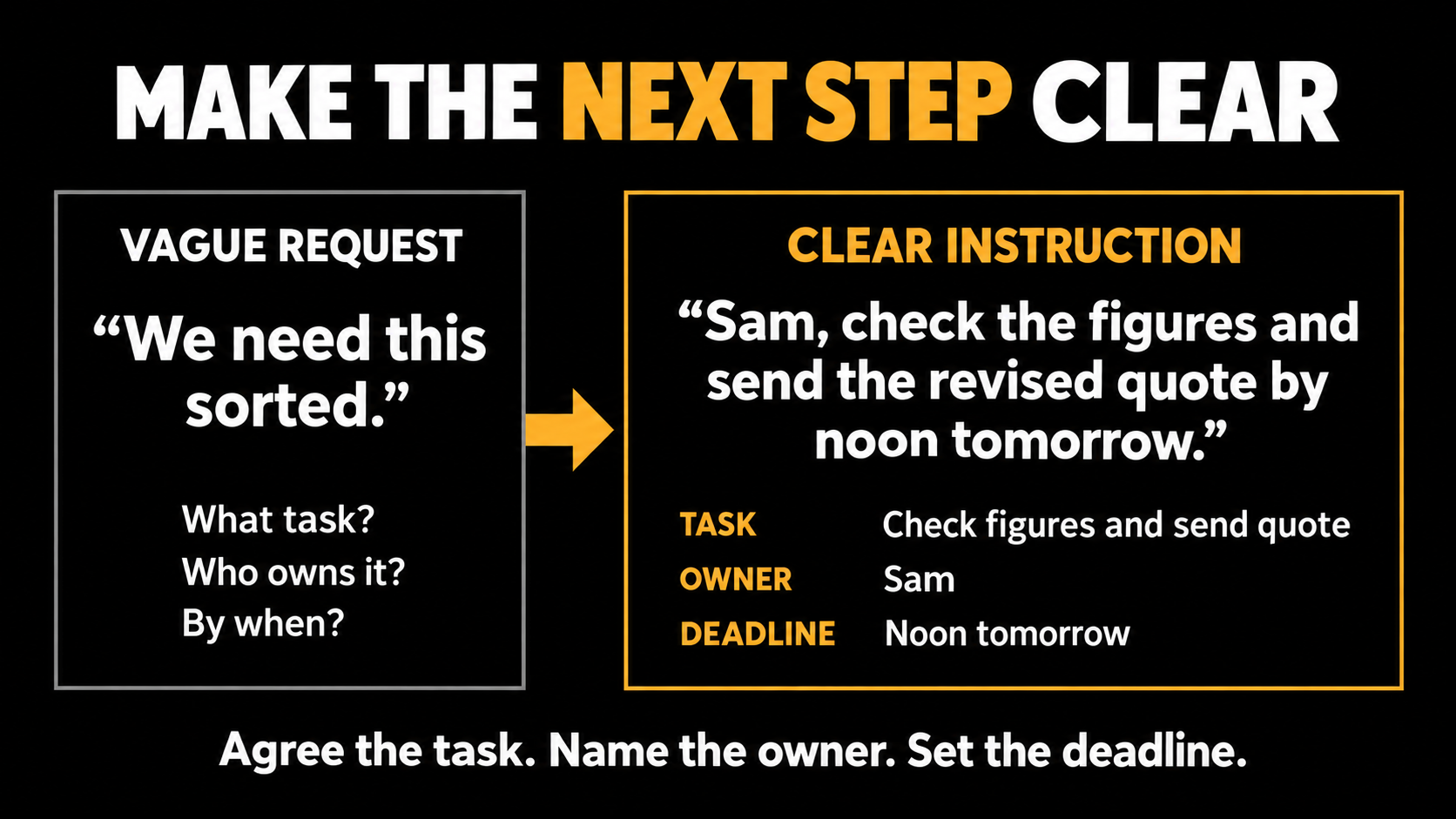
“We need to get this sorted.”
It sounds purposeful. Yet who is doing what?
In an illustrative office example, a client needs an updated quote.
Sales assumes accounts will send it. Accounts assumes sales is still checking the figures.
The request exists. Ownership remains unclear.
Replace the general instruction with a named action:
“Sam, please check the figures and send the revised quote by noon tomorrow.”
Then check that Sam has the information, authority and time required.
HSE’s Management Standards include role clarity and avoiding conflicting roles. Clear responsibilities deserve attention beyond a single task. HSE
4. Important Details Disappear Between Teams
A message reaches the next person, but part of its meaning has changed.
Imagine a site manager requesting materials for Tuesday morning.
The request passes through a supervisor, an office colleague and a supplier.
By the final conversation, “Tuesday morning” has become “sometime Tuesday”.
This illustrative example shows why timing and context need to travel together.
Identify the details that must survive each handover.
What is required? By when? Why does that timing matter?
Ask the person passing it on to preserve those points.
For important changes, keep an accessible written record and confirm that the affected people received the update.
5. The Same Explanation Keeps Coming Back
You have explained the task twice. The questions continue.
Repeating yourself may feel like the obvious response.
First, find out which part remains unclear.
Ask:
“What do you need to know before you can move forward?”
They might need evidence, a worked example, a clear priority or an explanation of how the task affects others.
Adapt your delivery to that need.
You could show the finished result, explain the reasoning or break the task into steps.
Then ask them to describe their next action.
Poor communication in the workplace may persist when a repeated explanation never addresses the listener’s actual question.
6. Concerns Arrive After Decisions
The decision is made. Only then do you hear:
“We knew that might happen.”
Find out when the concern arose and what happened to it.
Was it raised but overlooked? Was responsibility unclear? Did someone lack a suitable opportunity to speak?
Before an important decision, ask:
“What information could change this decision?”
Follow with:
“What have we not checked yet?”
HSE’s guidance on organisational change supports timely information, consultation and opportunities for employees to influence proposals. HSE
Apply that principle thoughtfully: involve people who hold relevant information while there is still time to use it.
7. Questions Are Heard as Criticism
“Why did you do it that way?”
One person intends to understand. Another hears blame.
The words alone may leave the purpose unclear.
Confusion caused by unclear messages
Explain what you are trying to discover:
“I want to understand the decision so we can work out the next step.”
Then ask about the facts.
“What information did you have at the time?”
Listen before forming your conclusion. Acas guidance recommends asking questions and avoiding making up your mind before hearing the whole story. acas.org.uk
You can still address an error. Understanding how it happened helps you choose a response that fits the issue.
Prevent Misunderstandings With The Communication Compass
Spotting poor communication in the workplace gives you a starting point. The next step is choosing how to respond.
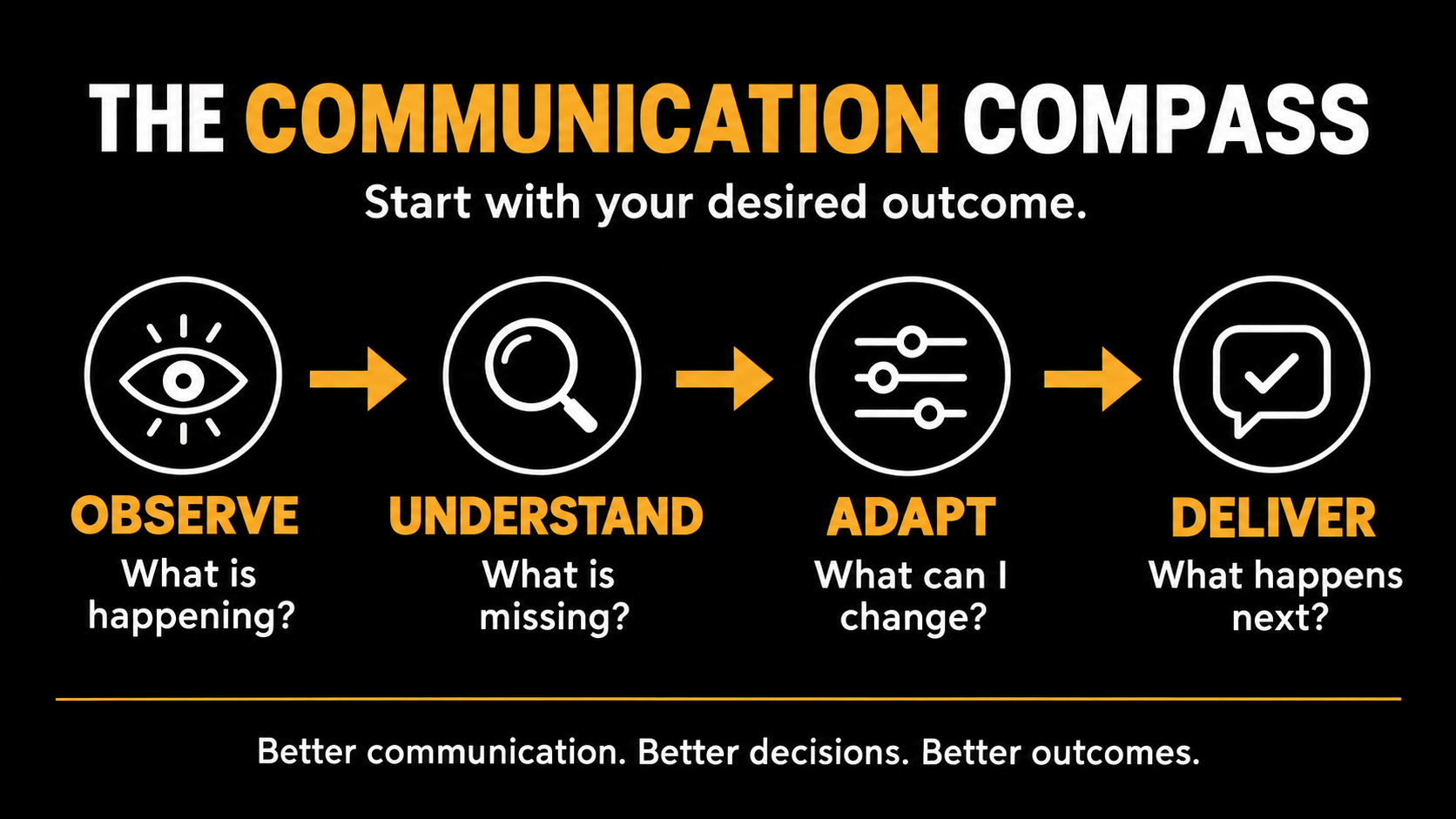
The Communication Compass uses four stages:
Observe → Understand → Adapt → Deliver
Before using them, decide your desired outcome.
Perhaps you need an agreed deadline, a clear handover or enough information to make a decision.
Keep that outcome in mind as you work through each stage.
Observe: Notice What Is Happening
Look for what you can establish.
A deadline was missed. Two versions of an instruction exist. A question remains unanswered.
Separate those observations from your interpretation.
“They missed the deadline” describes an event.
“They don’t care” assumes a reason.
That reason needs checking.
Understand: Discover What Is Missing
Ask questions before deciding where the problem lies.
What did the person understand? What information did they receive? What prevented the agreed action?
Listen to the answer, even when it challenges your first view.
The aim is to understand the situation well enough to respond usefully.
Adapt: Change Your Contribution
Use what you have discovered.
If ownership was unclear, name the owner.
If the explanation lacked context, supply it.
If the person needs evidence, provide relevant facts.
You may also need to change the channel or timing.
A hurried message may need a conversation, followed by a written record.
Deliver: Make the Next Step Clear
State the agreed action in plain language.
Confirm who will act, by when and what support they need.
Ask them to explain their understanding of the next step.
For important tasks, agree when you will check progress.
That follow-up gives you a chance to discover a remaining gap before it becomes a larger problem.
Start With One Conversation
You do not need to redesign every meeting today.
Choose one task where misunderstandings keep appearing.
Before the next conversation, write down the outcome you need.
During it, check the other person’s understanding.
Afterwards, record the action, owner and deadline.
At the agreed review, ask whether the information was sufficient and what still needs clearing up.
This gives you something specific to examine.
Addressing poor communication in the workplace becomes more useful when you can identify the gap and check whether it improved.
FAQ’s
Q. What causes poor communication in the workplace?
Possible causes include unclear instructions, missing context, assumptions and uncertain responsibilities. Information may also change as people pass it on. Investigate the specific situation before deciding the cause.
Q. How can managers check understanding without sounding patronising?
Make the check a shared responsibility. Say, “Let’s check we have the same next steps.” Ask for the person’s understanding, then clarify any differences respectfully.
Q. Does better communication always mean more meetings?
No. The response should fit the gap. A clear written instruction may be enough. A complex or sensitive issue may need a conversation and written confirmation.
Final Thoughts
Poor communication in the workplace deserves a closer look than “I already told them”.
Ask what was understood, what was missing and what happened next.
Observe the facts. Understand the gap. Adapt your contribution. Deliver a clear next step.
Think like a detective.
Don’t start by deciding. Start by discovering.
